
If you are thinking about buying properties in Spain, the Costa Blanca around Torrevieja is one of the first places many British buyers look: apartments near the salt lakes, houses on the Orihuela Costa, and quieter inland towns in the Vega Baja. This guide explains how the purchase works, which official taxes apply in the Valencian Community as of November 2026, and how to find property consultants in Spain who work in English – together with an independent lawyer of your own.
You can compare local firms on our list of estate agents on the Costa Blanca. Every listing shows the town, the languages the company states that it speaks, and how to contact them directly – we never sit in between.
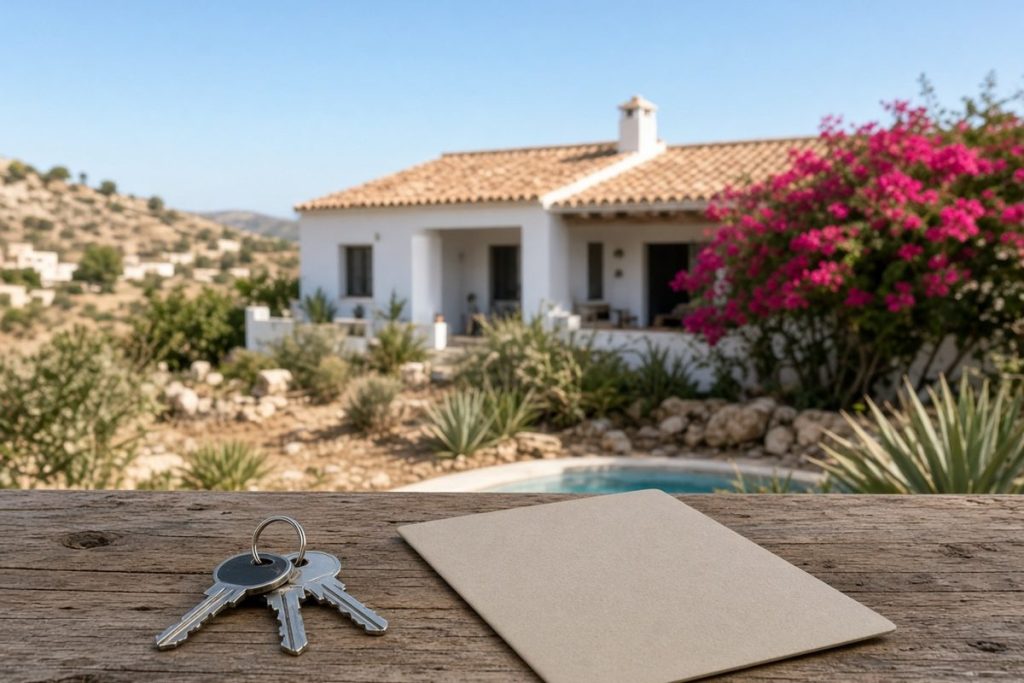
Why British buyers look at properties in Spain on the Costa Blanca
British citizens can still buy a home in Spain after Brexit. You will need a Spanish foreigner identification number (NIE) for the deed, the taxes and, in practice, a Spanish bank account. Buying a property does not, by itself, give you the right to live in Spain all year. Unless you hold a visa or a residence permit, short stays follow the usual Schengen rules. This is general information as of November 2026, not immigration advice – check the current rules before you plan a move.
The coast and the inland towns feel different. In and around Torrevieja and the Orihuela Costa you will find many apartments and villas in urbanisations with communal pools. A short drive inland, in the Vega Baja, towns such as Rojales and Ciudad Quesada, Almoradí, Los Montesinos and San Miguel de Salinas, and Dolores and Catral often have a quieter street scene and a more local daily life. Our Vega Baja area guide is a starting point for the towns we cover.
Buying in a specific town? Read our local guides to buying property in Los Montesinos and San Miguel de Salinas, buying property in Catral, buying property in Dolores, buying a house in Almoradí, buying property in Ciudad Quesada and Rojales, buying property in Orihuela (the historic city), and on the coast buying property in Guardamar del Segura and buying property in Santa Pola and Gran Alacant.
How buying properties in Spain actually works
The legal steps are the same whether you buy in Torrevieja or further inland, as long as the property is in Spain. The taxes, however, depend on the autonomous community – the rates below apply in the Valencian Community (including Alicante province). If you buy in the Region of Murcia, the tax rates are set there and are not the same; your lawyer must check the rate that applies to that deed.
- Get your NIE early. The NIE (Número de Identidad de Extranjero) is the identification number the Spanish administration gives to foreigners for tax and official paperwork. You can apply in Spain, at a Spanish consulate, or through a representative with a power of attorney. There is a small official fee (form 790). A NIE is not a residence permit.
- Instruct an independent lawyer before you pay a reservation. The notary authenticates the final deed; the notary does not act as your adviser or carry out the checks that protect you. A lawyer who works only for you should review the reservation document and the property before you commit funds.
- Legal checks. Typical due diligence includes a land-registry extract (nota simple) to confirm ownership and any mortgages or charges; the Cadastre (Catastro) description and floor area; enquiries at the town hall about council tax (IBI), licences and planning; and the community of owners’ fees and any pending special levies (derramas). Extensions, terraces or pools that do not match the registered description are a common issue on the Costa Blanca and should be cleared up before completion, not after.
- Reservation, then the deposit contract. A reservation fee, if you pay one, should be documented: who holds the money, whether it is refundable, and what happens if the checks reveal a problem. The next contract is often a deposit agreement (contrato de arras). In practice the deposit is frequently around 10% of the price, but the figure and the penalties if either side withdraws are those written in the contract, not a fixed legal rate.
- Sign the deed at the notary. The balance is paid in a traceable way (a bank transfer or a banker’s draft), the escritura is signed, and you receive the keys. If you cannot be in Spain, a power of attorney can allow your lawyer to sign for you.
- Register the purchase and pay the tax. The buyer must file the transfer-tax return (form 600) and pay the tax within one month of the deed. The purchase should also be inscribed at the Land Registry. Your lawyer or a gestoría can handle the filings; the obligation remains yours.
One extra rule matters when the seller is not tax-resident in Spain. In that case the buyer must withhold 3% of the agreed price and pay it to the Spanish tax agency (form 211) within one month, as a payment on account of the seller’s tax. If that amount is not paid, the property itself can be held liable. Your lawyer should confirm the seller’s tax residence before completion.
Official taxes and fees in the Valencian Community
The main tax depends on whether you buy a resale home or a new home from a developer. The figures below are the official rates in the Valencian Community as of November 2026, after the changes that took effect on 1 June 2026. Reduced rates exist in limited cases (for example certain primary residences); a lawyer should confirm what applies to your purchase.
For a resale property you pay transfer tax (ITP / TPO). The general rate is 9%. If the value of the property (or of the right transferred) is more than €1,000,000, the rate is 11% on the whole value, not only on the excess. The tax is calculated on the official cadastral reference value, or on the declared or agreed price if that is higher. Source: the Valencian tax agency (ATV – Generalitat Valenciana).
For a new home sold by a developer you do not pay ITP. You normally pay VAT (IVA) at 10% on the price, plus stamp duty (AJD) on the deed. The general AJD rate in the Valencian Community is 1.4%; a reduced rate of 0.1% applies to the first copies of deeds for the acquisition of a primary residence (vivienda habitual). Source for AJD: ATV.
On top of the tax come notary and Land Registry fees, which follow official tariffs and vary with the price and the complexity of the deed, and the fees of your lawyer and, if you use one, a gestoría. Those professional fees are agreed with the firm – get them in writing before you start. We do not publish invented euro amounts or a single “total percentage”, because the extras are not a fixed official rate. Ask your lawyer for a written breakdown for the specific property.
This is general information as of November 2026, not personal legal or tax advice.
Property consultants in Spain, and a lawyer of your own
A good agent helps you find and judge the property. That is not the same job as a lawyer, who checks title, debts and contracts, or a gestoría, which can help with the NIE, tax filings and utility set-up. Use an independent lawyer even if the agent is helpful, and confirm when you call who will actually advise you and in which language. Language tags on our listings are declared by the companies themselves.
In Torrevieja, several estate agents list English among their languages, including Kolstad Property (Danish, English, Norwegian and Swedish), Fastighetsbyrån Torrevieja, SkandiaMäklarna Torrevieja and Mentzoni & Skumlien Invest. Alegria Real Estate has its head office in Torrevieja and a website available in English and German, among other languages. Inland, in Almoradí, J. L. Morales Real Estate lists English, French, German, Dutch and Spanish, and Igloo Servicios Inmobiliarios lists English. Browse the full estate agents category for more firms along the coast.
For legal work in Torrevieja you will find CNG Lawyers (English and Dutch) and Bufete Padilla, a firm in the town since 1976 whose listed languages include English, German and French. Compare more firms under lawyers. For the NIE and later paperwork, Advisors Costa Blanca in Torrevieja works in English, and Tax & Law Almoradí (HP Tax) lists English, French, German and Spanish. See also gestorías and tax advisers.
After you collect the keys
Once the deed is signed you still have running costs: the municipal property tax (IBI), refuse charges, community fees if the home is in an urbanisation, utilities, and home insurance. For a holiday home that will stand empty, read our guide to house insurance in Torrevieja and to key holding, and compare key holding companies. Non-resident owners also have annual Spanish tax filings (often form 210), even if the home is not rented. A tax adviser can tell you what you must file.
In short
If you are buying properties in Spain on the Costa Blanca, start the NIE early, use an independent lawyer before you pay a reservation, budget first for the official tax – 9% ITP on most resales in the Valencian Community, or 10% VAT plus AJD on a new build – and add notary, registry and legal fees from a written estimate. Compare property consultants in Spain and English-speaking lawyers around Torrevieja and the Vega Baja on Sunny Spain Life, and contact them directly.