
Buying property in Catral means buying in a working Spanish farming town rather than a coastal resort. Catral sits in the north of the Vega Baja, between the irrigated orchards of the Segura valley and the El Hondo wetlands, about half an hour inland from Torrevieja. This guide explains what the town is like, the kinds of homes you will find there – from old town houses to country houses in the huerta – and the extra checks and official Valencian taxes to know about as of November 2026.
For the general process on the Costa Blanca, start with our main guide to buying properties in Spain. Here we focus on what is particular to Catral.
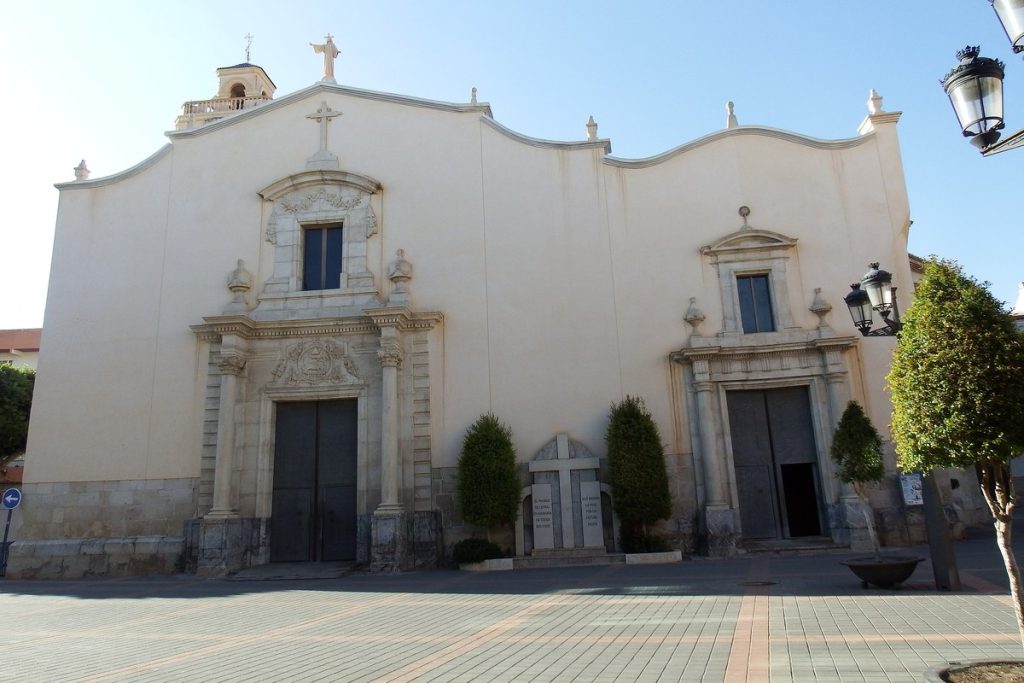
The Church of the Santos Juanes on its paved square in Catral. Photo: 19Tarrestnom65, CC BY-SA 4.0, via Wikimedia Commons (cropped and resized).
Catral: a farming town at the gateway to the Vega Baja
Catral has about 9,600 inhabitants (INE 2025) and is sometimes called “the gateway to the Vega Baja”. It is an old town: it bought its title of villa and its independence from Orihuela in 1741, after the draining of the surrounding marshes in the early 18th century – promoted by Cardinal Belluga – had greatly enlarged its farmland. The parish Church of the Santos Juanes, shown above, stands in the centre. Every year the town still gives thanks to Saint Emygdius for having been spared in the earthquake of 21 March 1829 that damaged much of the area.
Farming remains part of daily life. The town’s huerta is irrigated by the Acequia Mayor and smaller channels, and citrus fruit and artichokes are typical crops. To the north-east lies the El Hondo natural park, an important wetland for birds. Catral is a Spanish-speaking municipality, and you will hear far more Spanish in the streets than on the coast – a plus for many buyers, but worth knowing if you do not speak the language yet.
Location and getting around
Catral borders Dolores to the east, Almoradí to the south, San Felipe Neri to the north, San Isidro to the west, and Callosa de Segura and Orihuela to the south-west. By road it is about 5 km to Dolores, about 10 km to Almoradí, about 20 km to Elche, about 21 km to Guardamar del Segura and about 27 km to Torrevieja. Alicante-Elche airport is roughly 30–40 km away depending on the route. The A-7 and AP-7 motorways pass close to the town, and Albatera-Catral railway station, on the Alicante–Murcia line, is about 3 km from the centre.
Catral and Dolores share our Dolores and Catral area guide, which lists local businesses and practical facts. For most trades and professional services, people in Catral use firms in Almoradí, ten minutes away.
What kind of property you find in Catral
In the town centre the typical home is the Spanish town house (casa de pueblo), usually terraced, often on two floors, sometimes with a patio or roof terrace; there are also apartment blocks and newer townhouses at the edges of town. Outside the centre, among the orchards, you will find country houses (casas de campo) and small rural properties (fincas) on larger plots. We do not quote prices – ask several agents for current listings and recent sales.
Older town houses can be good value, but plan for a proper survey: ask a builder or surveyor to look at the roof, damp, the electrics and the plumbing before you sign the deposit contract, and remember that renovation work needs the right licence from the town hall. Almoradí builders such as Cocow Constructora (Spanish) state that they renovate homes across the Vega Baja.
Extra checks for country houses and older homes
Rural and older properties need more legal homework than a modern apartment. Ask your independent lawyer to cover at least these points:
- Land classification and licences. Much of the countryside is classed as non-developable land (suelo no urbanizable), where building is strictly limited. Check at the town hall that the house, any extensions, the pool and outbuildings were built legally, and that all buildings are declared in the deeds (declaración de obra nueva) and match the Cadastre. Buildings that exist on the ground but not on paper can be hard to legalise, insure or mortgage.
- Flood risk. Parts of the Vega Baja were badly flooded in the DANA storm of September 2019. Ask your lawyer to check the plot on the official flood maps – the Valencian PATRICOVA plan and the Spanish national flood-zone mapping (SNCZI) – and ask your insurer whether flood cover has any conditions.
- Access, water and drainage. Confirm that access is along a public road or a registered right of way, how drinking water is supplied, and whether the house is connected to the sewer or uses a septic tank. If the land has irrigation, ask how the water is supplied and what it costs.
- Holiday lets. In the Valencian Community a home let to tourists for stays of up to 10 days must be registered in the tourism register, which requires a favourable town-hall report on planning compatibility for tourist use. Do not assume a country house can be let – check first.
Step by step: buying property in Catral
- NIE and bank account. Apply for your NIE (Número de Identidad de Extranjero) early – in Spain, at a Spanish consulate or through a representative with a power of attorney (small official fee, form 790) – and open a Spanish bank account for taxes and utilities. A NIE is not a residence permit.
- Independent lawyer first. Instruct a lawyer who works only for you before paying any reservation. The notary authenticates the deed but is not your adviser.
- Checks. Land-registry extract (nota simple) for ownership, mortgages and charges; Cadastre description; town-hall enquiries on licences, planning and IBI; plus the rural checks above.
- Deposit contract. The contrato de arras sets the deposit – in practice often around 10% – and the penalties if either side withdraws. Make sure the contract says what happens if a legal problem appears.
- Deed at the notary. Sign the escritura, pay the balance by traceable bank transfer or banker’s draft, and collect the keys. There is a notary’s office in Almoradí, Notaría Pérez Juan, which lists English, French and German; compare others under notaries.
- Tax and registration. File and pay the transfer tax (form 600) within one month of the deed and inscribe the purchase at the Land Registry. If the seller is not tax-resident in Spain, withhold 3% of the price and pay it to the Spanish tax agency on form 211 within one month.
Official taxes for a purchase in Catral
Catral is in Alicante province, so Valencian rates apply. According to the Valencian tax agency (ATV), the general transfer-tax rate (ITP) on a resale property is 9% for purchases from 1 June 2026, and 11% on the whole value above €1,000,000. The base is the Cadastre reference value, or the declared or agreed price if higher – which matters for older houses and rural plots, where the reference value and the price you agree may differ.
A new home from a developer normally carries VAT (IVA) at 10% instead of ITP, plus stamp duty (AJD) of 1.4%, or 0.1% on first copies of deeds for buying a primary residence (ATV). Reduced rates exist in some specific cases. Notary, registry and professional fees come on top and vary with the property; ask for a written estimate. General information as of November 2026, not personal legal or tax advice.
Agents, lawyers and advisers near Catral
Almoradí, ten minutes south, is where most of the nearby professional firms are. J.L. Morales Real Estate lists English, French, Dutch, German and Spanish, and Igloo Servicios Inmobiliarios lists English. For independent legal advice, Hernández Mora Abogados focuses on foreign clients and lists English, French, Dutch and Spanish. For the NIE, non-resident taxes and paperwork, Tax&Law Almoradí (HP Tax) lists English, French, German and Spanish.
Compare more firms under estate agents, lawyers and gestorías. Language tags on our listings are declared by the companies themselves, so confirm who will advise you, and in which language.
Nearby towns to compare
Neighbouring Dolores has a similar farming character and shares our area guide; Almoradí is the larger service town to the south, and Rojales and Ciudad Quesada are closer to the coast. If you would rather be near the Torrevieja lagoon, read our guide to buying property in Los Montesinos and San Miguel de Salinas. See all towns in our Vega Baja area guide.
In short
Buying property in Catral offers traditional Spanish town life close to Almoradí, Elche and the El Hondo wetlands. Get your NIE early, use an independent lawyer, check licences, land classification and flood risk carefully – especially for country houses – and budget for 9% ITP on most resales, or 10% VAT plus AJD on a new build, plus fees from a written estimate. Then compare agents and lawyers on Sunny Spain Life and contact them directly.