
Buying property in Orihuela – the historic inland city, not Orihuela Costa – means buying in the old capital of the Vega Baja, on the river Segura at the foot of the Sierra de Orihuela, close to the border with the Region of Murcia. Orihuela Costa belongs to the same municipality but lies about 30 km away on the coast, and the two feel completely different. This guide is about the city and its surrounding villages: what Orihuela is like, the kinds of homes you will find, the checks that matter here and the official Valencian taxes as of November 2026.
For the general process on the Costa Blanca, start with our main guide to buying properties in Spain. Here we focus on what is particular to Orihuela.
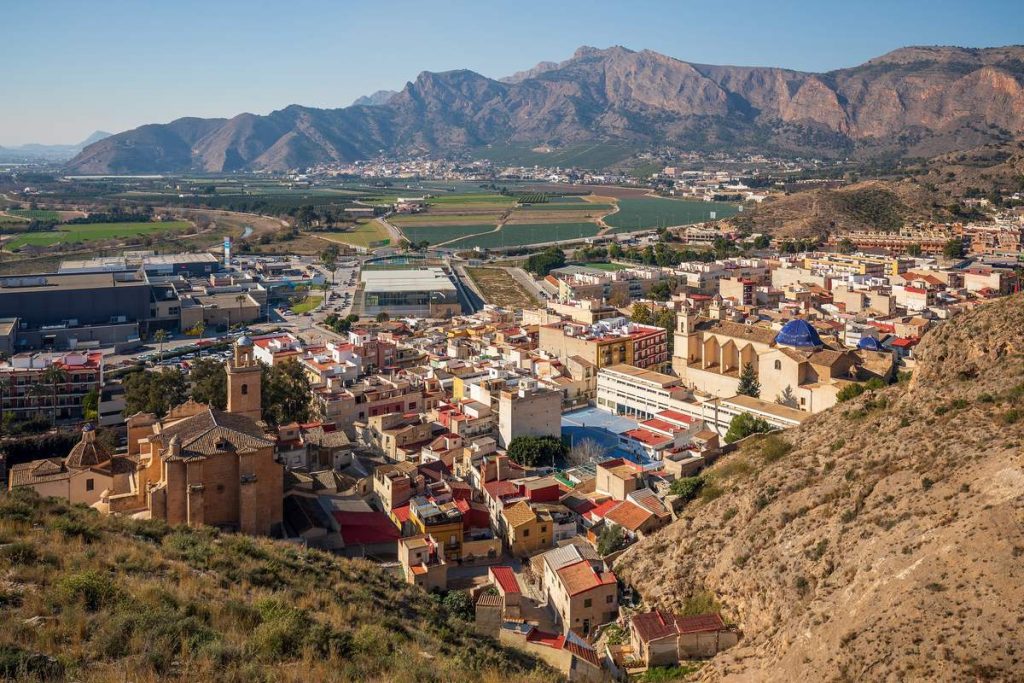
Orihuela seen from the Seminary of San Miguel, with the old town, the huerta and the Sierra de Orihuela behind. Photo: Ximonic (Simo Räsänen), CC BY-SA 4.0, via Wikimedia Commons (cropped and resized).
Orihuela city or Orihuela Costa? Know which one you are buying in
The municipality of Orihuela is the largest in Alicante province by area and has about 84,600 inhabitants (INE 2025: 84,560). Only around a third of them live in the city itself (INE 2023: 32,617 in the urban core). Many others live on Orihuela Costa – the coastal urbanisations such as La Zenia, Playa Flamenca, Cabo Roig and Campoamor – and the rest in more than twenty rural districts (pedanías) such as La Murada, San Bartolomé, La Aparecida, Desamparados, Hurchillo and Torremendo.
So an advert that says “Orihuela” can mean a flat in the old city, a farmhouse in the huerta or an apartment by the sea. The Cadastre reference and the land-registry extract show the exact location. If you are looking for a coastal home, compare listings under Orihuela Costa; this page is for buyers who want the Spanish city.
Orihuela, Spain: a historic city in the Vega Baja
Orihuela (Oriola in Valencian) is a Spanish-speaking city with a long history as a regional capital and bishop’s see. Its historic centre was declared a historic-artistic ensemble in 1969, one of the first in Spain, and is full of churches, palaces and convents – among them the cathedral and the former University of Santo Domingo. The poet Miguel Hernández was born here, and his house is now a museum. Holy Week in Orihuela is a Festival of International Tourist Interest, and the Moors and Christians celebrations in July are of National Tourist Interest. The Palmeral de San Antón, an old date-palm grove, lies at the edge of the city, and the Miguel Hernández University has two campuses in Orihuela.
The city stands about 23 metres above sea level on the banks of the Segura, surrounded by the irrigated farmland of the huerta and the rocky Sierra de Orihuela. Daily life is Spanish: you will hear far less English than on the coast, and some Spanish will make everything from the town hall to the market easier.
Location and getting around
By road, Orihuela is about 7 km from Bigastro, about 20 km from Los Montesinos, about 25 km from Rojales, and about 30 km from both Torrevieja and Orihuela Costa (roughly half an hour). Murcia city is about 30 km away and Almoradí around 20 minutes. Alicante-Elche airport is roughly 55 km away and Región de Murcia airport at Corvera about the same, each typically just under an hour by car. Distances are approximate road distances.
Orihuela-Miguel Hernández railway station is on the Murcia–Alicante local rail (Cercanías) line, and since February 2021 it has had direct high-speed (AVE) trains to Madrid. The area’s reference public hospital, Hospital Universitario Vega Baja, is in San Bartolomé within the municipality, roughly 15 minutes from the centre. For businesses in and around the city, see our Orihuela and Vega Baja directory.
What kind of property you find in Orihuela
In the city, most homes are apartments in blocks of various ages, along with Spanish town houses (casas de pueblo) and some larger historic buildings in and around the old centre. Newer flats and townhouses are found in the expanding districts, and in the pedanías and the huerta there are village houses, country houses and small farms on larger plots. New-build homes are also offered in and around the city. We do not quote prices – ask several agents for current listings and recent sales.
For an older property, plan a proper survey before you sign anything: roof, damp, structure, electrics and plumbing. Renovation needs the right licence from the town hall. Local trades include the Orihuela electrician Eléctricas Jomaga and the joinery Tarimed (both Spanish-speaking), and Reformas Vega Baja (Spanish) states that it renovates homes in Orihuela.
Local checks that matter in Orihuela
Ask your independent lawyer to cover at least these points:
- Historic centre and protected buildings. In the protected historic centre, and for buildings in the town’s catalogue of protected heritage, works on façades, roofs and layout can face extra conditions. If you plan to renovate, ask the town hall’s planning department what is allowed before you commit.
- Flood risk. The Segura runs right through the city, and Orihuela has a long history of floods – from the Santa Teresa flood of 1879 to the DANA storm of September 2019, which hit the Vega Baja hard. Check the exact plot and its access road on the official flood maps – the Valencian PATRICOVA plan and the national SNCZI mapping – and ask your insurer about flood conditions.
- Land classification and licences. For country houses in the huerta or the pedanías, check whether the land is non-developable (suelo no urbanizable), that every building, extension and pool is legal and declared in the deeds, and that the deeds match the Cadastre.
- Older apartment blocks. Ask the community of owners for the fees, the latest minutes and any planned special levies (derramas) – for example for a lift, façade or roof – and get a certificate that the seller has no unpaid debts.
- Access, water and drainage. Outside the city, confirm public access or a registered right of way, how drinking water is supplied and whether the house is connected to the sewer or uses a septic tank.
- Holiday lets. In the Valencian Community a tourist let of up to 10 days must be registered in the tourism register, which needs a favourable town-hall report. Check before you buy if letting matters to you.
Step by step: buying property in Orihuela
- NIE and bank account. Apply for your NIE (Número de Identidad de Extranjero) early – in Spain, at a Spanish consulate or through a representative with a power of attorney (small official fee, form 790) – and open a Spanish bank account. A NIE is not a residence permit: owning a home does not give UK citizens the right to live in Spain, and without a visa or residence you are limited to 90 days in any 180-day period in the Schengen area.
- Independent lawyer first. Instruct a lawyer who works only for you before paying any reservation. The notary authenticates the deed but is not your adviser.
- Checks. Nota simple for ownership, mortgages and charges; Cadastre description; town-hall enquiries on licences, planning, heritage protection and IBI; plus the local checks above.
- Deposit contract. The contrato de arras sets the deposit – in practice often around 10% – and the penalties if either side withdraws.
- Deed at the notary. Sign the escritura, pay the balance by traceable transfer or banker’s draft and collect the keys. In Almoradí, Notaría Pérez Juan lists English, French and German; compare others under notaries.
- Tax and registration. File and pay the transfer tax (form 600) within one month of the deed, and register the purchase at the Land Registry. If the seller is not tax-resident in Spain, withhold 3% of the price and pay it to the Spanish tax agency on form 211 within one month.
Official taxes for a purchase in Orihuela
Orihuela is in Alicante province, so Valencian rates apply – even though Murcia is only a short drive away, Murcian rates do not. According to the Valencian tax agency (ATV), the general transfer-tax rate (ITP) on a resale property is 9% for purchases from 1 June 2026, and 11% where the value is above €1,000,000. The base is the Cadastre reference value, or the declared or agreed price if higher.
A new home bought from a developer normally carries VAT (IVA) at 10% instead of ITP, plus stamp duty (AJD) of 1.4%, or 0.1% on the deed for buying your primary residence (ATV tariff table). Reduced rates exist in some specific cases. Notary, registry and professional fees come on top; ask for a written estimate. Once you own the home, budget for IBI and refuse charges, and – if you are not resident in Spain – an annual non-resident income tax return. General information as of November 2026, not personal legal or tax advice.
Agents, lawyers and advisers near Orihuela
We do not yet list an estate agent or law firm based in Orihuela city. The nearest cluster of professional firms on Sunny Spain Life is in Almoradí, around 20 minutes away. J.L. Morales Real Estate lists English, French, Dutch, German and Spanish, and Igloo Servicios Inmobiliarios lists English. For independent legal advice, Hernández Mora Abogados lists English, French, Dutch and Spanish. For the NIE, non-resident taxes and paperwork, Tax&Law Almoradí (HP Tax) lists English, French, German and Spanish, and Cecoem Asesores lists English.
Compare more firms under estate agents, lawyers and gestorías. Language tags on our listings are declared by the companies themselves, so confirm who will advise you, and in which language.
Nearby towns to compare
Closer to the coast, read our guides to buying a house in Almoradí, buying property in Ciudad Quesada and Rojales and buying property in Los Montesinos and San Miguel de Salinas. To the north-east are buying property in Dolores and buying property in Catral. For a home by the sea, see buying property in Guardamar del Segura. See all towns in our Vega Baja area guide.
In short
Buying property in Orihuela gives you a historic Spanish city with a high-speed rail link, a university and the coast half an hour away – but it is not Orihuela Costa, so check exactly where a property lies. Get your NIE early, use an independent lawyer, check flood risk, licences and any heritage protection carefully, and budget for 9% ITP on most resales, or 10% VAT plus AJD on a new build, plus fees from a written estimate. Then compare agents and lawyers on Sunny Spain Life and contact them directly.